Chapter 4
A week passed.
I went to work every day, put on a smile, pretended everything was fine.
But it wasn’t fine.
Nothing was fine.
I lived on takeout.
The house got messier and messier.
Laundry piled up in the corner of the bedroom.
Dust collected on every surface.
I tried to cook once.
I burned the pasta so bad the smoke alarm went off.
I threw the whole pot in the trash and ordered pizza.
I called my husband every night.
He never answered.
I texted.
He never replied.
I sent my daughter long, apologetic messages, telling her how sorry I was, how much I loved her, how I’d change.
She left them all on read.
I made the therapist appointment like he’d told me to.
Dr. Rao.
A woman in her 50s with kind eyes and gray hair pulled back in a tight bun.
The first session was the hardest hour of my life.
I sat on her couch and told her everything.
All the yelling.
All the throwing things.
The slap.
The pension money.
The cot in the storage room.
I cried through most of it.
She just listened.
She didn’t judge me.
She didn’t call me a monster.
At the end of the hour, she said something that stuck with me.
“People who hurt others like this are almost always hurting themselves too,” she said.
“We’ll find out why you did this, Mia. And we’ll fix it. But it’s going to take work. A lot of hard, painful work. Are you ready for that?”
I nodded.
I was ready.
I’d do anything to get my family back.
That Friday, I decided to go to my daughter’s high school.
I knew my husband had said not to.
I knew I was risking him pressing charges.
But I couldn’t wait anymore.
I had to see her.
I had to look her in the eye and tell her I was sorry.
I parked across the street from the school 10 minutes before the final bell.
I leaned against my car and waited.
When the bell rang, hundreds of kids poured out the front doors.
I scanned the crowd, looking for her long brown hair, her favorite blue backpack.
There she was.
Walking with a group of her friends, laughing at something one of them had said.
For a second, she looked like my little girl again.
The one who used to climb into my bed after a bad dream.
The one who used to tell me I was the best mom in the whole world.
Then she saw me.
Her smile died.
She said something to her friends, and they walked on ahead.
She crossed the street toward me, her face hard, her eyes cold.
“What are you doing here?” she said, stopping a few feet away.
“Dad said not to come near the school. You could get us all in trouble.”
“I had to see you,” I said.
My voice cracked.
“I miss you, baby. So much. The house is so empty without you. I’m sorry. I’m so, so sorry for everything I did. I’m in therapy now. I’m going to change. I promise.”
She stared at me.
“Sorry doesn’t fix the slap,” she said, her voice flat.
“Sorry doesn’t fix the three years you made Grandma sleep on that hard cot in the storage room because you said the guest room was for your drunk friends to pass out in. Sorry doesn’t fix the nights I’d sneak down there with extra blankets because she was freezing, and she’d beg me not to tell you because she was scared you’d yell at both of us.”
My mouth went dry.
I’d had no idea.
I’d had no idea my daughter was sneaking blankets in the middle of the night.
I’d had no idea she was that scared of me.
“I didn’t know,” I whispered.
“I swear, I didn’t know.”
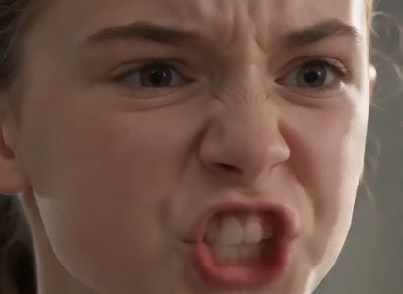
“Of course you didn’t know,” she said, and now her voice was shaking, tears spilling down her cheeks.
“You never paid attention to any of us! You only cared about your parties and your shoes and how everything looked to your stupid friends! Grandma would cry every night after you went to sleep. She’d say she was a burden, that she should just go live in a shelter because she wasn’t good enough for your house. And I’d sit there and hold her and there was nothing I could do! I was just a kid! I was scared you’d hit me too if I said anything!”
She was crying hard now.
Other kids were staring as they walked past.
I reached out to touch her arm.
She flinched and stepped back.
Like I was going to hit her.
Like I was a stranger who meant her harm.
That hurt worse than any slap.
Worse than any name she could call me.
“I will never hit you,” I said, my own tears coming now.
“Or Grandma. Or Dad. Ever again. I swear on my life. I know I was a terrible person. I know I hurt all of you. But I’m going to be better. I’m going to be the mom you deserve. The daughter-in-law Grandma deserves. The wife Dad deserves. Just give me a chance. Please.”
She wiped her face with the back of her hand.
She looked at me for a long time, like she was trying to decide if I was telling the truth.
“One chance,” she said finally.
“That’s all you get. And you don’t get it by saying sorry. You get it by doing. Prove to me you’ve changed. Prove to Grandma you’re not going to hurt her again. And then… maybe… we can talk.”
She turned and walked away.
She didn’t look back.
I stood there on the sidewalk, watching her go.
My heart was broken.
But for the first time in a week, I had a tiny spark of hope.
One chance.
That was all I needed.
I got in my car and drove home.
I walked straight to the storage room.
I grabbed the cot and dragged it out to the curb for the trash.
I stripped the sheets off the guest room bed—the one I’d reserved for my friends—and remade it with the soft, expensive linen set I’d been saving for “special occasions.”
I bought a new memory foam mattress topper.
I hung curtains.
I put a vase of fresh flowers on the nightstand.
I moved all of my mother-in-law’s things—her books, her photos, her old knitting supplies—from the storage room into the guest room.
I worked until midnight, until the room was warm and bright and comfortable.
Until it was a room someone would be happy to sleep in.
I stood in the doorway and looked at it.
It was a start.
A small start.
But it was something.
I went to bed that night feeling better than I had in days.
I had a plan.
I had a chance.
May you like
I was going to prove to them I’d changed.
No matter what it took.