Chapter 1
The text pinged at 9:47 a.m. on a Tuesday in Palo Alto.
My dissertation drafts covered every inch of the kitchen table, next to a coffee gone cold and a half-eaten everything bagel I’d forgotten existed.
For eight straight years, I’d worked three part-time jobs.
I stocked shelves at the campus library until midnight. Tutored high school math on weekends. Pulled opening shifts at a café where the steam burned my wrists every winter.
I ate instant noodles for every meal. Rode my rusted bike through rainstorms and 100-degree heat, its broken chain fixed so many times I could do it blindfolded. Never bought a single new item of clothing. Not even socks.
All to save $72,041.
Enough for my Stanford PhD tuition. Enough to fund my research on solar microgrids for villages trapped in endless, dangerous night.
I checked that balance every Sunday night. Wrote the number in a beat-up notebook, like saying it out loud would make it real.
Then my phone buzzed again.
It was my mom.
“Sarah, your dad and I took every dollar from your savings account. Derek needs his MBA, that’s the only degree with a real future. Your research is just a waste of time.”
I stared at the screen.
Read it once. Twice. Three times, waiting for the words to rearrange into something that made sense.
My hands started shaking so hard the coffee mug slipped.
Brown liquid flooded across my thesis pages, blurring the equations I’d spent three years refining.
The room went dead quiet.
The next morning, I defended my dissertation anyway.
I walked into that room in a thrifted blazer, voice steady, and talked for two hours about microgrid efficiency and energy equity.
I passed.
My advisor, Dr. Hale, hugged me so tight my shoulders ached. Tears ran down her face.
“Congratulations, Dr. Sarah Mitchell.”
I almost cried then. Not from pride. From the sharp, empty knowledge that no one else would ever say those words to me like they mattered.
Three days later, I stood alone in a cheap motel mirror, adjusting my doctoral hood with a safety pin.
No one fixed the lopsided sleeve of my robe.
No family waited outside with flowers.
No one held up a camera when my name was called.
I walked across the Stanford stage to cheers from strangers.
That night, I ate cold lo mein alone on my couch and updated my email signature to Sarah Mitchell, PhD.
I checked my phone every five minutes.
Waiting for the words I’d craved my whole life. We’re proud of you. We love you. Come home, let’s celebrate.
Instead, my mom sent four cold words.
“Did it go okay?”
Not congratulations.
Not we’re sorry.
Just that.
Something inside me shattered so quietly I almost didn’t hear it.
I stopped chasing their approval entirely.
I poured every part of myself into the work they’d called useless.
I joined Solar Reach, a tiny startup in a cramped Bay Area office with broken desk chairs and laptops that died mid-meeting.
We failed more times than I can count.
Batteries overheated in field tests.
Rural install projects collapsed overnight when local governments pulled permits.
Investors walked out mid-pitch, laughing at our “unrealistic” mission to power the world’s poorest places.
Twice we packed our office boxes, sure we were done for good.
Then everything changed.
One small village in Kenya lit up after dark for the first time in history.
Kids ran through the dirt streets screaming, their faces glowing under bare bulbs.
A grandmother held my calloused hand and said, “We don’t have to be afraid of the dark anymore.”
Then another village lit up.
Then a dozen more.
Clinics kept life-saving vaccines cold overnight.
Kids studied under bright electric lights instead of flickering, toxic candles that burned down houses every year.
Small shops stayed open late, giving families a chance to build real, lasting hope.
The dream they’d mocked was changing millions of lives.
By 2026, Solar Reach was valued at over $420 million.
Then Stanford called me back.
Not as a graduate.
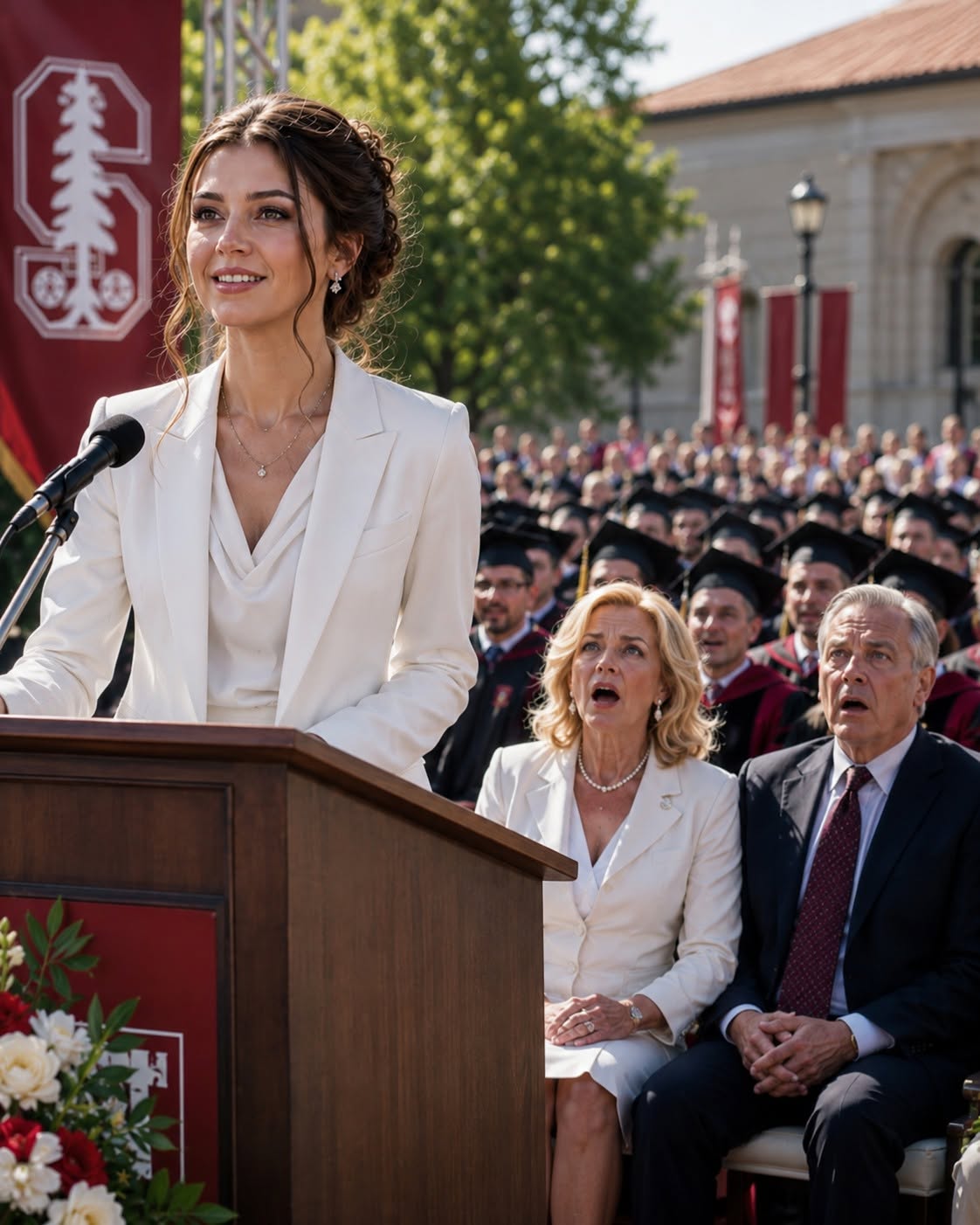
As the official keynote speaker for the MBA commencement.
My brother Derek’s graduation.
My parents flew to California three days early.
They booked a suite at the fanciest hotel in town, planned celebratory dinners at Michelin-star restaurants, packed three cameras, and bragged to every neighbor and relative back home about their brilliant son’s big day.
They had no clue I was waiting backstage.
They had no idea my entire speech opened with the exact text my mom sent the day she stole my life savings.
From behind the heavy velvet curtain, I spotted them in Section 114.
Mom wore a crisp cream blazer, beaming so wide her cheeks glowed.
Dad held his phone high above the crowd, ready to record every single second of Derek’s moment.
Derek sat in the front row of graduates, grinning, his gown perfectly pressed.
Then the dean stepped to the center of the stage.
He didn’t introduce me as Derek’s older sister.
He didn’t call me anyone’s daughter.
He smiled, adjusted his mic, and said, “Please welcome Dr. Sarah Mitchell, co-founder of Solar Reach, whose work has brought clean, life-changing power to more than 3 million people worldwide.”
I took a deep breath and walked out into the blinding stage lights.
May you like



Before I even reached the podium, I locked eyes with my mom.
And I watched her proud, beaming smile slowly, completely vanish from her face.