Chapter 3
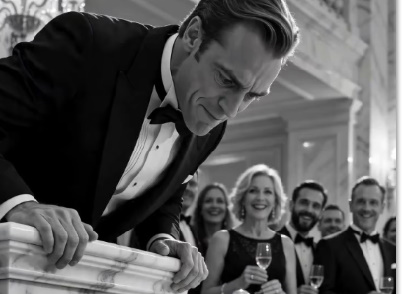
The elevator was lined with mirrors, and I stared at my reflection the whole ride up.
I looked like a street kid next to Arthur.
My hair was a mess, my jacket had a hole in the elbow, my jeans were stained at the knees.
Arthur didn’t look at me.
He stared straight ahead, his jaw tight, his hands clasped so hard his knuckles were white.
The elevator dinged on the top floor.
The whole level was his penthouse, floor-to-ceiling windows looking out over the city’s glittering lights.
It was bigger than our entire apartment building.
I stood in the entryway, too scared to step further, like I’d get dirt on the white carpet.
“Come in,” Arthur said.
He walked into the kitchen, pulling off his tuxedo jacket and tossing it over a chair.
“Make yourself at home.
I’ll order something to eat.
Whatever you want.”
I hesitated, then walked to the couch and sat on the very edge, my backpack tight in my lap.
The leather was softer than anything I’d ever felt.
A few minutes later, there was a knock on the door.
A waiter rolled in a cart piled high with food—pasta, bread, fruit, a whole chocolate cake.
My mouth watered.
I hadn’t eaten a hot meal in two weeks.
Arthur waited until the waiter left, then pushed the cart toward me.
“Eat,” he said.
“Please.”
I didn’t need to be told twice.
I ate fast, shoveling pasta into my mouth, trying not to look like a starving animal.
Arthur sat across from me, just watching, his eyes sad.
When I was full, I wiped my mouth on the back of my hand.
He poured me a glass of water, then sat back.
“Tell me about her,” he said.
“Tell me everything.”
So I did.
I told him about Mom’s laugh, loud and snorty when she found something really funny.
I told him about how she’d worked three jobs to keep me in school, how she’d never missed a single one of my piano recitals even when she was exhausted.
I told him about the first time she’d gotten sick, how she’d hidden it from me for months because she didn’t want me to worry.
I told him about the eviction, about sleeping in the car, about the alley behind the diner where the owner would slip me free pancakes on cold mornings.
I told him about her last night, how she’d held my hand and made me promise to play the song for him one day.
I didn’t cry.
I’d cried all my tears in the alley.
But Arthur did.
He sat there, a sixty-two-year-old billionaire, and cried silent tears into his glass of water.
When I finished, he was quiet for a long time.
Then he reached into his pocket and pulled out a worn, folded photo.
He slid it across the table to me.
It was a young Arthur, barely twenty, holding a swaddled baby.
He was smiling so wide his eyes crinkled.
The baby was Clara.
“I was nineteen when she was born,” he said.
His voice was rough.
“My parents were furious.
They said I’d ruined my life, that a baby would hold me back.
They told me to leave, to go build my career, that they’d take care of her and her mom.
I was stupid.
I was scared.
I left.
I came back six months later, and the house was empty.
My sister Marge gave me a letter.
Said Clara’s mom had moved across the country, said she didn’t want me anywhere near them.
I believed her.
I never looked for Clara.
I just… buried it.
I built this hotel, I made all this money, and I told myself I’d done the right thing.”
He leaned forward, his elbows on his knees.
“I’m so sorry, Lila.
There’s no excuse.
I failed her.
I failed you.
And I can never make that right.”
I stared at the photo, running my finger over Clara’s tiny face.
I wanted to hate him.
I’d hated him for so long, blamed him for every bad thing that had ever happened to us.
But sitting there, looking at him broken, I couldn’t.
He’d been lied to.
He’d been young and stupid, and his own family had manipulated him.
“You can start by making sure no one else goes through what we did,” I said.
I set the photo down.
“Mom used to say that regret is useless unless you do something with it.”
He nodded, wiping his face with the back of his hand.
“I will,” he said.
“I swear to you, I will.
Whatever you need.
School, a home, anything.
It’s yours.”
I shook my head.
“I don’t want your money,” I said.
“I want to get to know you.
If you want that too.
Slow.
No pressure.”
A small, wobbly smile spread across his face.
It was the first real smile I’d seen from him.
“I’d like that more than anything,” he said.
We sat there for hours, talking, until the sun started to come up over the city.
May you like

For the first time since Mom died, I didn’t feel alone.
But neither of us knew that Marge was listening outside the penthouse door, her face twisted with rage, already planning how to take everything away from me.