Chapter 1
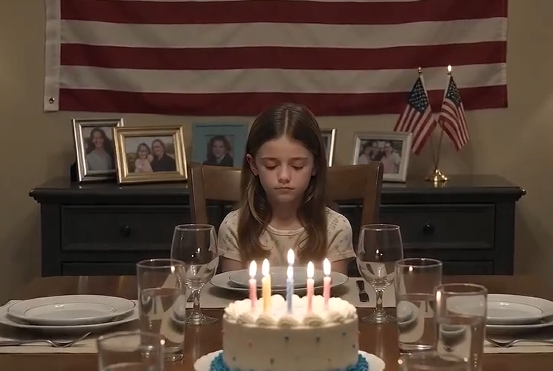
The first thing Mia watched from the backseat wasn’t the balloons tied to my parents’ porch rail.
It was the front door.
Her small fingers plucked at the pink plastic brace on her right leg, the one Dr. Caldwell had warned me a hundred times was non-negotiable. Three months prior, he’d rebuilt her knee—congenital defect, he’d called it, the kind that made her buckle mid-step if she so much as forgot to lock the hinge once a day.
The setting sun caught the hinge, glinting like a tiny warning.
“Mommy,” she said, twisting her gray stuffed bunny’s ear until the fabric stretched thin. “Do we have to stay long?”
I unbuckled her, my palm brushing the warm curve of her cheek.
“Just long enough to sing to Grandpa and eat a slice of cake,” I said. “I’ll be right beside you the whole time. I promise.”
I meant it.
I’d spent three years keeping my head down, hiding the truth of who I was to protect her. My parents’ house was the last place I wanted to be, but it was Dad’s sixtieth. Skipping it would have given them more ammunition than they already had.
Roast beef and candle smoke curled through the screen door before I could lift Mia out.
Mom pulled it open, her smile so wide it didn’t reach her eyes.
“There they are,” she said, her voice sharp as broken glass. “The celebrities finally decided to show up.”
Her gaze dropped straight to Mia’s leg. She huffed that half-laugh, half-sigh sound she’d used my whole life when she thought I was being difficult.
“Still wearing that contraption, I see.”
“It’s prescribed,” I said.
That was my first mistake.
Believing facts could survive in a room that had already picked its punchline.
Helen turned from the dining table, wine glass in one hand, her blonde hair pulled so tight it pulled the skin at her temples. My older sister. The woman who’d bought Mia her first bunny, who’d posted a dozen photos of them on Instagram with captions like “my little mini-me,” who’d once told a stranger Mia was “basically hers too” when the cameras were flashing.
Care is easy when it photographs well.
It gets harder when a child needs patience instead of applause.
Dad lifted his beer like he was holding court over the whole room.
“Try not to make tonight about yourself, kiddo,” he said.
The table chuckled.
That was our family language. Hurt someone, call it humor, make the injured party apologize for bleeding.
Mia pressed tighter into my side, her bunny squished between us.
I tried to shrink the night down to something small enough for her to bear. I fixed her a plate of soft carrots and mashed potatoes, moved a dining chair so her leg could stretch straight out, kept my palm warm on her back when everyone crowded around the cake to sing.
Then she shifted her weight.
Sucked in a breath so quiet almost no one heard it.
I heard it.
“Pain?” I whispered, leaning down.
She nodded, biting her lip so hard the skin turned white, fighting not to cry in front of them.
I guided her toward the den, where the old armchair was soft enough to sink into. We were halfway past the sideboard when Helen stepped directly in our path.
Like she’d been waiting for the whole room to watch.
“Tired already?” she said, tilting her head. “You’ve been here five whole minutes.”
Mia stared at her scuffed sneakers. “My leg really does hurt.”
Helen bent low, her smile so sweet it curdled.
“You’re six years old,” she said, her voice low enough only we could hear, but loud enough to carry to the nearest tables. “Old enough to tell real pain from just wanting people to look at you.”
My jaw locked so hard I tasted metal.
I put one hand firm on Mia’s shoulder, stepping between them.
“Back off, Helen.”
Forks slowed.
Glasses paused halfway to mouths.
Mom’s face tightened. Not because Helen had cornered a six-year-old. Because I’d finally talked back.
Dad slammed his fork down hard enough to rattle his plate.
“Can we get through one goddamned dinner without your martyr act?” he snapped.
That’s when the doorbell rang.
For one stupid second, I thought it was a reprieve.
I took Mia with me. I wasn’t leaving her within arm’s reach of Helen, not for a second.
I pulled the door open.
Dr. Caldwell stood on the porch, scrubs peeking out under a worn wool coat, black medical case in one hand, a crumpled gift bag in the other. He looked exhausted, like he’d just come straight from the OR.
Then he saw Mia, and his whole face softened.
“I was across town finishing a surgery,” he said. “Got your text about the hinge sticking this morning. Figured I’d swing by, adjust it, bring her that lollipop she begged for last week.”
Mia’s whole face lit up, the first real smile she’d had all night.
“Dr. Cal!”
I led him inside.
The dining room went quiet for ten long seconds. Cruel people get careful when a stranger can name exactly what they’re doing.
I introduced him as Mia’s orthopedic surgeon.
Mom smiled too bright, like she could charm him into agreeing with her. Dad looked annoyed, like a doctor showing up was just another way I was ruining the party. Helen glanced him over once, decided he was just some working stiff with no money or connections, and dismissed him entirely.
Then she leaned against the sideboard, swirling her wine, and called across the room.
“Hey, Doc,” she said. “How much longer does this whole brace charade have to go on? Some of us think my niece just likes being the center of attention.”
The room held its breath.
Then let it out wrong.
Mark, my cousin, snickered into his beer. Aunt Diane choked out a laugh behind her napkin. Mom sighed, like Helen was being blunt but not entirely wrong.
Dr. Caldwell didn’t look at any of them.
He crouched down until his eyes were level with Mia’s, his voice gentle as rain.
“Sweetheart,” he said. “Are you hurting right now?”
She nodded, fresh tears spilling over.
He reached for his medical case.
Helen moved first.
Her heels tapped fast, angry across the hardwood, closing the distance before I could grab her wrist. Her fingers hooked under the top Velcro strap of Mia’s brace, hard and sharp, like she was ripping a price tag off a clearance coat.
“No, she isn’t,” she snarled. “She’s faking.”
“DON’T TOUCH HER!” I screamed.
The Velcro tore with a sound so sharp it split the room clean in two.
The brace didn’t come free. It twisted, yanking Mia’s small leg sideways with a sickening little pop I felt in my own bones.
Her knee buckled.
She hit the floor before I could get my arms around her.
Her gray bunny skidded under the dining table, one ear torn clean off.
The scream that left her wasn’t a tantrum. It was terror, raw and white-hot, the kind of sound that burrows into your chest and never leaves.
For one ugly second, no one moved.
Forks hovered over plates. Aunt Diane’s wineglass trembled in her hand. Dad’s birthday candles flickered behind his beer, stupid and cheerful, like a little girl wasn’t screaming on the floor three feet away. Mark stared at his phone like the hardwood hadn’t just swallowed his cousin’s kid whole. Mom’s hand gripped the back of a chair so hard her knuckles turned white—wood, instead of her granddaughter.
Nobody reached down.
Nobody cared.
Then Dad laughed first.
The others followed in broken, awkward pieces, like a six-year-old sobbing on the floor was just another one of my jokes.
Helen stood over her, chest heaving, screaming the words that still wake me up most nights.
“STOP PRETENDING YOU’RE DISABLED! YOU JUST WANT EVERYONE TO FEEL SORRY FOR YOU!”
I dropped to my knees beside Mia, my hands shaking so bad I could barely touch her.
“Don’t move, baby,” I whispered. “Not even an inch. I’ve got you. I’ve always got you.”
Her face was paper white. Her small hands fisted in my shirt so hard I could feel the fabric stretch. The brace lay half-open, one strap twisted tight around her swollen knee, the hinge cracked clean down the middle.
Then the air behind me shifted.
Dr. Caldwell stepped over Mia’s torn bunny, his boots thudding heavy on the floor. He didn’t look at me. He looked straight at Helen, his face cold as stone.
He set his black medical case down right beside Mia’s shaking leg, and clicked the latches open.
And for the first time all night.
Helen’s smile disappeared.
Because Dr. Caldwell wasn’t just reaching for bandages.
He was pulling out his phone, and a small police-issue body camera he’d clipped to his coat pocket, and a folded piece of paper I’d never seen before.
“You know,” he said, his voice loud enough for the whole room to hear. “I was wondering when I’d get to use this. The restraining order you filed against me last week? For ‘harassing’ you when you tried to pay me fifty thousand dollars to lie and say this little girl didn’t need her brace?”
The room went dead silent.
Helen’s face drained of all color.
May you like
And I knew.
The war I’d spent three years running from had just landed on my parents’ dining room floor.