Chapter 8
The trial lasted five days.
Five of the longest, hardest days of my life.
The courtroom was packed every day. Reporters, members of Diane’s church, supporters from the domestic violence shelter I’d been going to.
Everyone wanted to see the monster unmasked.
The prosecution went first.
Rita was brilliant.
She laid out the case like a master storyteller, building the picture of Diane’s life of abuse and manipulation piece by piece.
She played the video.
She showed the hospital photos of Mia’s bruises and burns.
She called Mark’s father to the stand, who testified about the abuse he’d witnessed forty years ago, about the lies Diane had told to keep Mark away from him.
She called the police officer who’d arrested Diane.
She called the CPS workers.
She called the pediatrician who’d examined Mia.
And then she called me.
I testified for three hours.
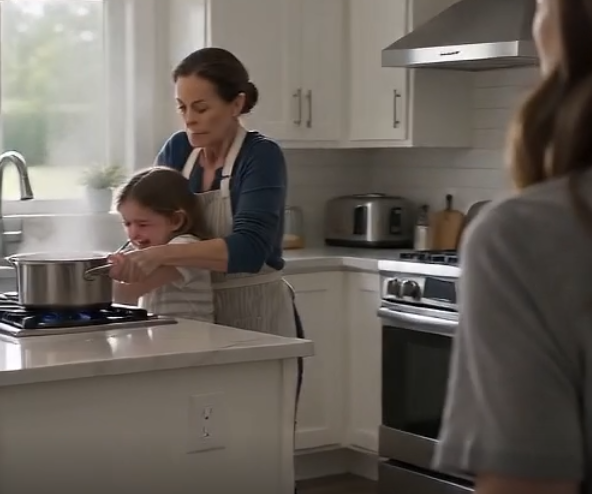
I told the court about coming home early. About hearing Mia’s whimper in the hallway. About what I’d seen in the kitchen.
I told them about all the red flags I’d missed. About the guilt I carried.
I told them about Mia’s nightmares. About how she still flinched sometimes when someone raised their hand too fast.
Diane’s lawyer cross-examined me hard.
He tried to make me look like an angry, vengeful wife who’d set his client up. He tried to say I’d coached Mia to lie, that I’d faked the bruises, that the video was edited.
But Rita was right there with objections, and the judge shut him down every time he went too far.
Then the defense had their turn.
Diane’s lawyer put her on the stand.
And she performed.
She cried. She trembled. She talked about what a hard life she’d had, raising Mark alone after her husband “died.” She talked about how much she loved Mia, how she’d only ever wanted what was best for her.
“I admit I was strict,” she said, dabbing at her eyes with a tissue. “But this generation of children is so spoiled, so entitled. Sometimes they need a firm hand. I never would have actually hurt her. I was just teaching her a lesson. That video was taken completely out of context. My daughter-in-law has always hated me. She’s been trying to turn my son and granddaughter against me for years.”
She was good.
I looked over at the jury.
A few of them were nodding. A few of them looked sympathetic.
My stomach dropped.
What if they believed her?
What if she walked free?
But then Rita stood up for cross-examination.
And she destroyed her.
She started with the lies about Mark’s father. She pulled out the old divorce papers, the custody battle records, the proof that he was alive and well in Florida.
Diane’s story started to crumble.
Then Rita brought up the night Diane had been caught outside the safe house.
The knife.
The gasoline.
The list of names.
“Ms. Carter,” Rita said, her voice like ice. “If you only ever wanted what was best for your granddaughter, why were you standing outside her shelter at two in the morning with a knife and a can of gasoline?”
Diane’s lawyer objected.
Overruled.
Diane’s face went red. Then white.
And then she snapped.
The mask fell off completely.
“Because she took everything from me!” she screamed, slamming her fists on the witness stand. “That little brat and her conniving mother! They turned my own son against me! They ruined my life! I should’ve done it when I had the chance! I should’ve—”
The judge banged his gavel.
“Order! Order in the court!”
But it was too late.
The jury had seen her.
The real Diane.
Not the grieving widow, not the sweet church lady.
The monster.
The rest of the trial was just a formality.
The jury deliberated for less than two hours.
Guilty on all counts.
Felony child cruelty. Aggravated stalking. Attempted murder.
The judge sentenced her to the maximum.
Thirty-five years in state prison, no possibility of parole.
Thirty-five years.
Diane would be ninety-seven before she got out.
She was never, ever getting out.
As the bailiffs led her away, she screamed and cursed and fought. She kicked at the officers, she spat at me, she screamed that she’d get out, that she’d find us, that she’d make us pay.
But nobody was listening anymore.
The monster was gone.
It was over.
After the trial, Mark and I stood on the steps of the courthouse, surrounded by reporters and cameras.
We didn’t say anything to the press.
We just stood there, side by side, watching the sun come out from behind the clouds.
It was over.
After three months of fear and pain and uncertainty, it was finally, truly over.
Mark turned to me.
He didn’t say anything.
He just held out his arms.
And this time, I didn’t step back.
I walked into them, and he held me, and for the first time in a long time, I let myself cry.
Not sad tears.
Relieved tears.
May you like

Happy tears.
It was over.